Abstract
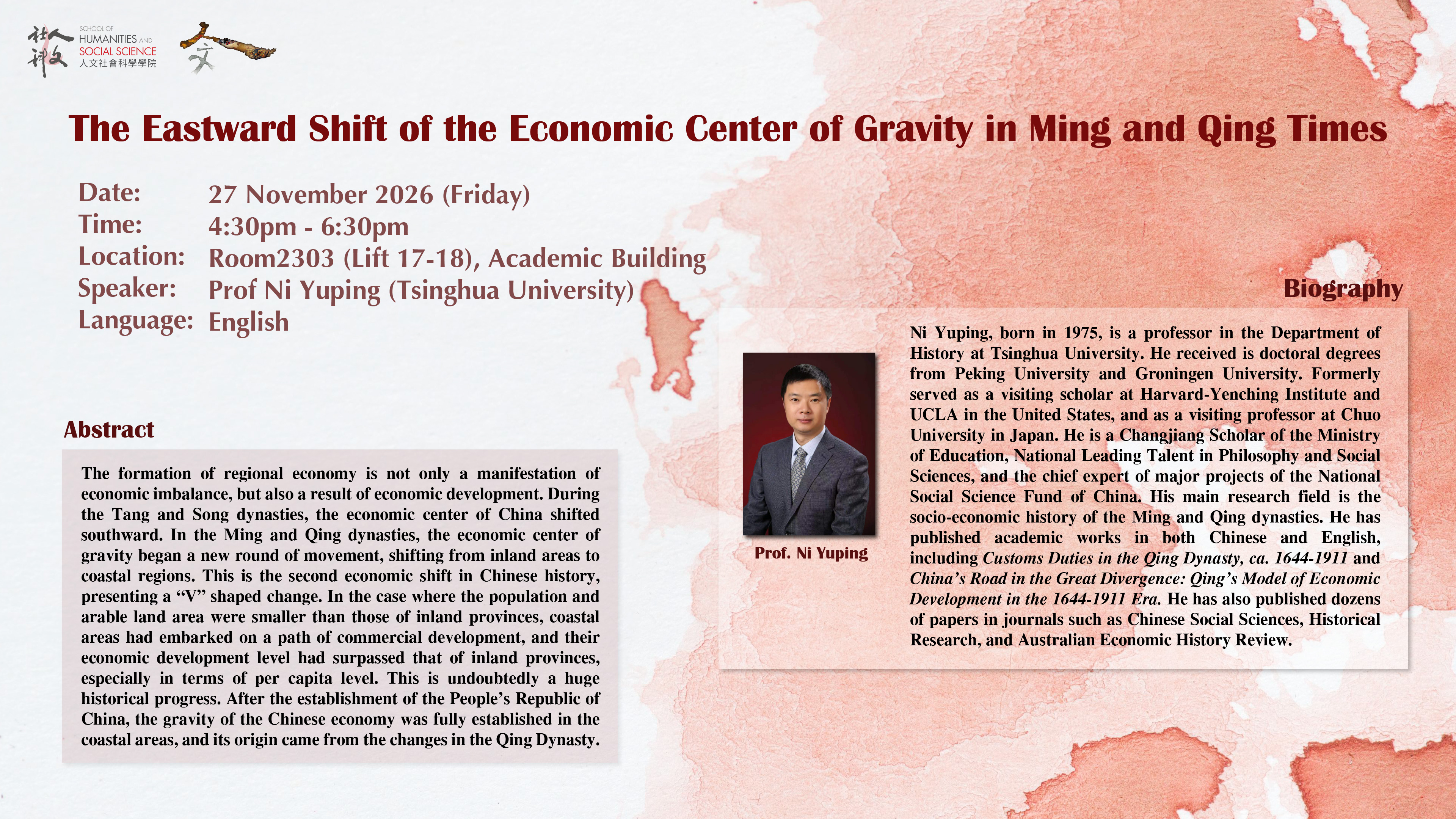
The formation of regional economy is not only a manifestation of economic imbalance, but also a result of economic development. During the Tang and Song dynasties, the economic center of China shifted southward. In the Ming and Qing dynasties, the economic center of gravity began a new round of movement, shifting from inland areas to coastal regions. This is the second economic shift in Chinese history, presenting a “V” shaped change. In the case where the population and arable land area were smaller than those of inland provinces, coastal areas had embarked on a path of commercial development, and their economic development level had surpassed that of inland provinces, especially in terms of per capita level. This is undoubtedly a huge historical progress. After the establishment of the People's Republic of China, the gravity of the Chinese economy was fully established in the coastal areas, and its origin came from the changes in the Qing Dynasty.
Biography
Ni Yuping, born in 1975, is a professor in the Department of History at Tsinghua University. He received his doctoral degrees from Peking University and Groningen University. Formerly served as a visiting scholar at Harvard-Yenching Institute and UCLA in the United States, and as a visiting professor at Chuo University in Japan. He is a Changjiang Scholar of the Ministry of Education, National Leading Talent in Philosophy and Social Sciences, and the chief expert of major projects of the National Social Science Fund of China.His main research field is the socio-economic history of the Ming and Qing dynasties. He has published academic works in both Chinese and English, including Customs Duties in the Qing Dynasty, ca. 1644-1911 and China's Road in the Great Divergence: Qing's Model of Economic Development in the 1644-1911 Era. He has also published dozens of papers in journals such as Chinese Social Sciences, Historical Research, and Australian Economic History Review.