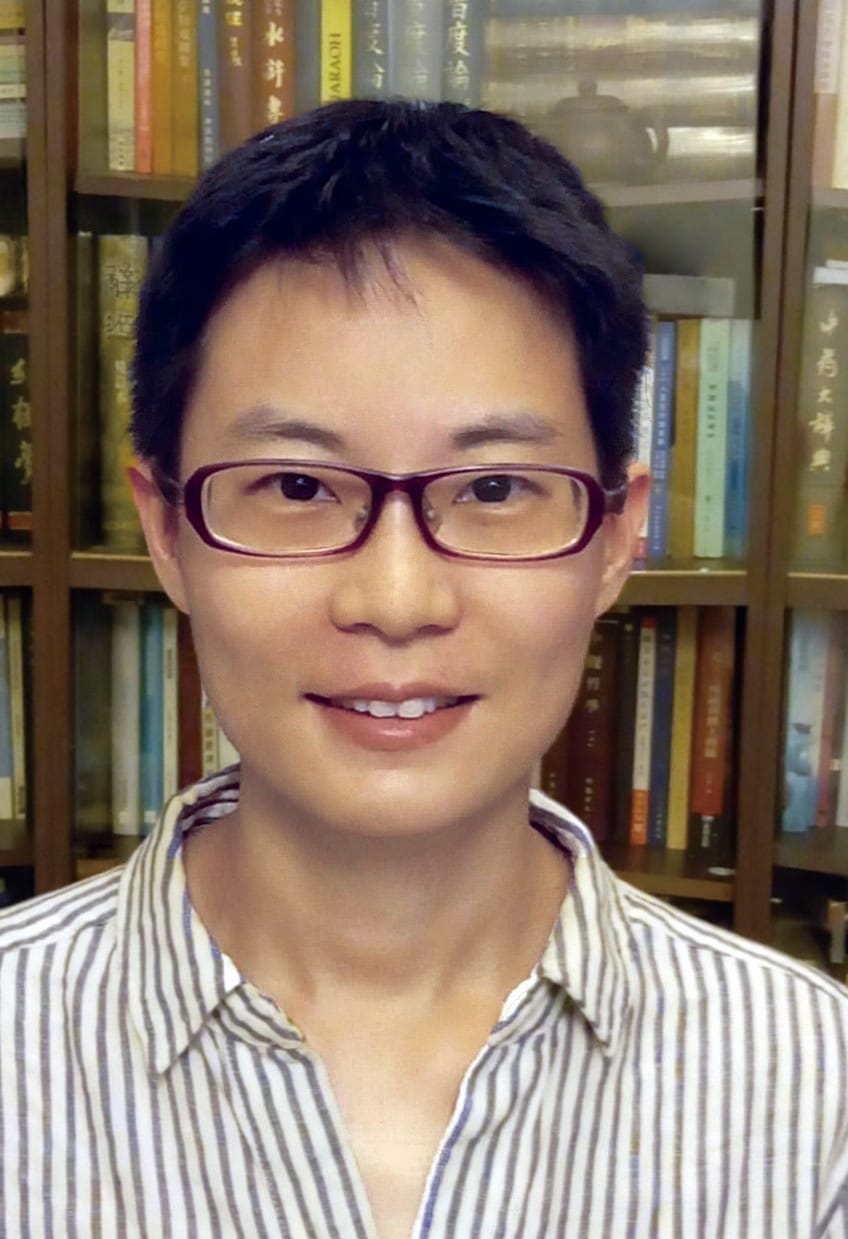
Jenny HUNG (洪真如)
Ph.D., The Hong Kong University of Science and Technology (2013) Ph.D., Lingnan University (2018)
Tel: 23587761
Email: hmjhung@ust.hk
Room No: 2349
Dr. Hung is an Assistant Professor in the Division of Humanities at HKUST and Mee Toh Visiting Associate Professor in the Department of Philosophy at the National University of Singapore.
She has two PhDs, one in philosophy and another in nanophysics.
She was recently awarded an ECS grant by the Hong Kong Research Grants Council for the project titled "Between Buddha-nature and Emptiness: The Peak Era of Chinese Buddhism."
Research Interests
Buddhism, Daoism, Philosophy of Mind, Metaphysics, Philosophy of Artificial Intelligence.
Representative Publications
Books
- Hung, J. (Forthcoming, 2026). Between Secularity and Spirituality. Buddhistdoor Press.
- Hung, J. Between Buddha-nature and Emptiness: The Peak Era of Chinese Buddhist Philosophy. Oxford University Press (Contract Signed)
- Hung, J. Between Identity and Unity: The Self Within Chinese Oneness Philosophy (Under Review)
- Hung, J. Meaning of Life in Chinese Buddhist Philosophy (In Progress)
- Hung, J. AI Buddhas, Transhumanism, and Immortality: Tiantai Spirituality in a Scientific World (In Progress)
Peer-reviewed Journal Papers (Philosophy)
- Hung, J. (Forthcoming). The Tiantai Meaning of Life. Philosophy East and West, 78:3.
- Hung, J. (Forthcoming). Exploring Challenges in the Neo-Brentanian Account of Awareness. Journal of Consciousness Studies.
- Hung, J. (2026). Better be a Zombie? The Value of Consciousness in Early Buddhism. Oxford Studies in Philosophy of Mind, Vol. 5: 339–363. DOI: 10.1093/9780198994121.003.0012
- Hung, J. (2025). We Are the Same Mind! A Study of Zongmi’s Idea of the True Mind. Philosophy East and West, 75:4. https://muse.jhu.edu/article/973413
- Hung, J. (2025). In Search of Qi Immortality: A Study of Heshanggongʼs Commentary on the Daodejing. Religions, 16(3): 383. https://doi.org/10.3390/rel16030383
- Hung, J. (2025). Is Emptiness Non-empty? Jizang’s Conception of Buddha-nature. Religions, 16(2), 184. https://doi.org/10.3390/rel16020184
- Hung, J. (2024). Reflexive Awareness and Reflexivity: An Identity Model of Reflexive Awareness with Korta and Perry’s Reflexive-Referential Theory of Content. Synthese. 204:30 https://doi.org/10.1007/s11229-024-04688-8
- Hung, J. (2023). Phenomenal Concepts and Animal Consciousness. Philosophical Psychology. 36 (3): 580–600. https://doi.org/10.1080/09515089.2022.2072722
- Gao J., Leung, H., Wu, W. W. Y., Hung, J., Chang, C., Sik, H. H. (2023). Long-Term Inquiry Meditation Reduces EEG Spectral Dynamics in Self-Schema Processing. Heliyon. 9(9), E20075. https://doi.org/10.1016/j.heliyon.2023.e20075
- Hung, J. (2020). Is Dharma-nature Identical to Ignorance? A study of “ji 即” in early Tiantai Buddhism. Asian Philosophy. Issue 30 (4): 307–323. http://dx.doi.org/10.1080/09552367.2020.1846873
- Hung, J. (2020). A Gricean Interpretation of Nāgārjuna’s Catuskoti and the No-thesis View. History and Philosophy of Logic. Vol. 41 (3): 217–235. https://doi.org/10.1080/01445340.2020.1786266
- Hung, J. (2020). Is Zhuangzi a Wanton? Observation and Transformation of Desires in the Zhuangzi. Dao: A Journal of Comparative Philosophy. 19 (2): 1–17. https://doi.org/10.1007/s11712-020-09723-2
- Hung, J. (2019). The Theory of the Self in the Zhuangzi: A Strawsonian Interpretation. Philosophy East and West 69:2, 376–394. https://muse.jhu.edu/article/731256
- Hung, J. (2018). The Early Yogācāra Theory of No-self. Asian Philosophy. 28.4: 316–331. https://doi.org/10.1080/09552367.2018.1543055
Peer-reviewed Journal Papers (Physics)
- Wang X., Gao W., Hung J., and Tam W. Y. (2014). Optical Activities of Large-area SU8 Micro-spirals Fabricated by Multi-beam Holographic Lithography., Appl. Opt. 53, 2425–2430. https://doi.org/10.1364/AO.53.002425
- Hung J., Gao W., and Tam W. Y. (2011). Optical Activities of Micro-spiral Photonic Crystals Fabricated by Multi-beam Holographic Lithography. J. Opt. 13, 095101. https://iopscience.iop.org/article/10.1088/2040-8978/13/9/095102/meta
- Hung J., Chan P. S., Sun C., Ho C. W. and Tam W. Y. (2010). Doubly Slanted Layer Structures in Holographic Gelatin Emulsions: Solar Concentrators. J. Opt. 12 045104. https://doi.org/10.1088/2040-8978/12/4/045104
- Hung J., Kok M., Tam W. Y. (2009). Complete Photonic Bandgaps in the Visible Range from Spherical Layer Structures in Dichromate Gelatin Emulsions. App. Phys. Lett. 94, 014102. https://aip.scitation.org/doi/10.1063/1.3064165
Book Chapters
- Hung, J. (Forthcoming). From Understanding to Contemplating Emptiness: Jizang’s Notion of Zhengguan 正觀. In “Buddhist Philosophy between India and China: From Madhyamaka to Sanlun.” Rafal Stepien (Ed.). Oxford University Press.
- Hung, J. (Forthcoming). Immortality and Human Enhancements From Zhu Xi’s Perspective.” In “Dao Companion to Confucian Applied Ethics.” Kam-Por Yu, Julia Tao, Rina Camus (Eds.). Springer Nature.
- Hung J. (Forthcoming). An Analysis of Jizang’s Idea of Reality. In “Reading Primary Sources in Asian Philosophies.” Malcolm Keating (Ed.). Bloomsbury.
- Hughes J. J, Sarbacker S., Tormen F., Hung, J. (Forthcoming). Buddhism, AI, and Human Enhancement. In “Consciousness, Ethics, and Co-Evolution in the Age of Intelligent Machines: Buddhist Perspectives.” Chiara Mascarello and Francesco Tormen (Eds.). Springer Nature.
- Adam, M., Tormen, F., Hung, J., Goodman, C. (Forthcoming). Can AI systems be Phenomenally Conscious? In “Consciousness, Ethics, and Co-Evolution in the Age of Intelligent Machines: Buddhist Perspectives.” Chiara Mascarello and Francesco Tormen (Eds.). Springer Nature.
- Hung, J. (2026). Introspection in Early Buddhism. In “The Routledge Handbook of Introspection.” Anna Giustina (Ed.). pp. 94–109. Routledge. DOI: 10.4324/9781003393269-8
- Hung J. (2024). Evil, Suffering, and Meditation in the Tiantai School. In Volume II, “Chinese Philosophy and Its Thinkers: From Ancient Times to the Present Day.” Selusi Ambrogio & Dawid Rogacz (Eds.). pp. 77–86. Bloomsbury.
- Hung, J. (2011). The Three-fold Interpretation of Chih-I’s ‘Ignorance Equals Nature of Dharma’ (in Chinese). In “Dialogues in Chinese, Japanese and Korean T'ien-T'ai Buddhism.” Tian Xiang Ma (Ed.). pp. 150–165. Beijing, Renmin Publisher.
Grants / Awards / Fellowships (selected)
- 2026 Mee Toh Foundation Visiting Professorship in Buddhist Studies (~SGD 30,000)
- 2026 Book Publication Fund, Prajna Paramita Charity Organization (HKD 5,000)
- 2025 – 2026 Co-Investigator, “Ethics in Chinese Philosophy”. Postgraduate Students Conference/Seminar Grants (Ref. No. PSCG25HS01). Research Grants Council (HKD 38,034)
- 2024 – 2027 Principal Investigator, “Between Buddha-nature and Emptiness: The Peak Era of Chinese Buddhism.” (Ref. No. 26600024). Early Career Scheme (ECS), Research Grants Council (HKD 340,249)
- 2023 – 2024 Research Grant, “The Self: Eastern and Western Traditions”. Stanford University (USD 33,000)
- 2020 RGC Postdoctoral Fellowship (Ref. No. PDFS2021-4H02). Research Grants Council (≃HKD 1,241,000)
- 2018 Reaching Out Award, HKSAR Government Scholarship Fund (HKD 10,000)